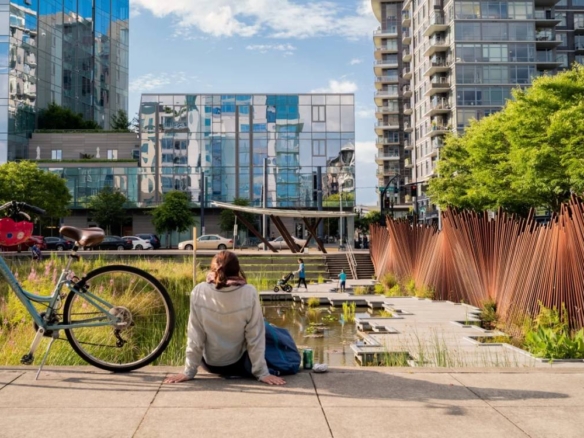
If Northeast Portland is the soul of the city, Southeast Portland is its personality. This is the neighborhood that people picture when they think of Portland at its most itself — eclectic coffee shops, vintage boutiques, food carts on every corner, bungalows with murals painted on the side, and the kind of independent energy that makes you feel like you’ve actually found somewhere real.
I’ll be honest — coming from LA, SE Portland was the neighborhood that surprised me the most. I expected to love it, but I didn’t expect it to feel like the kind of place that makes you want to cancel your plans and just walk around all day. That’s what Division Street does to you. That’s what Hawthorne does. You came for brunch, you stayed for four hours. That’s SE Portland.
Here’s the full, honest breakdown of what it’s actually like to live here.
What Is Southeast Portland?
Southeast Portland is the largest and most neighborhood-dense quadrant of the city, spanning from the Willamette River east to 82nd Avenue and beyond. It sits south of Burnside Street and is home to some of Portland’s most iconic streets — Hawthorne Boulevard, Division Street, Belmont Street, and Woodstock Boulevard among them.
What makes SE Portland unique is the sheer density of walkable commercial corridors packed into a relatively tight area. Unlike NE Portland, which spreads its energy across a few main streets, SE stacks five or six distinct corridors within a compact east-west band. The result is a neighborhood where you’re almost always within walking distance of something good — a great restaurant, an independent bookstore, a coffee shop worth lingering in.
This is the quadrant where Portland’s independent, corridor-driven identity is most concentrated, and it’s the reason most buyers who end up here say the dining and walkability sealed the deal before they ever ran the school numbers.
The Pros of Living in Southeast Portland
1. The food scene is the best in the city — maybe the best in the Pacific Northwest
This is the big one. Division Street alone has added more nationally recognized restaurants per block than any other Portland street in the last decade. The restaurant density is unreal. You have everything from James Beard Award-nominated spots to beloved neighborhood dives, food cart pods, Vietnamese holes-in-the-wall, Japanese ramen, and farm-to-table places that would have a months-long waitlist in LA or San Francisco.
Hawthorne Boulevard adds its own layer — more casual, more indie, more lived-in. And Belmont, just six blocks north of Hawthorne, has that same energy at a slightly quieter scale. Coming from Redondo Beach or Santa Monica where good food required a 20-minute drive minimum, having this much variety within walking distance is genuinely life-changing.
2. The neighborhood personality is unmatched
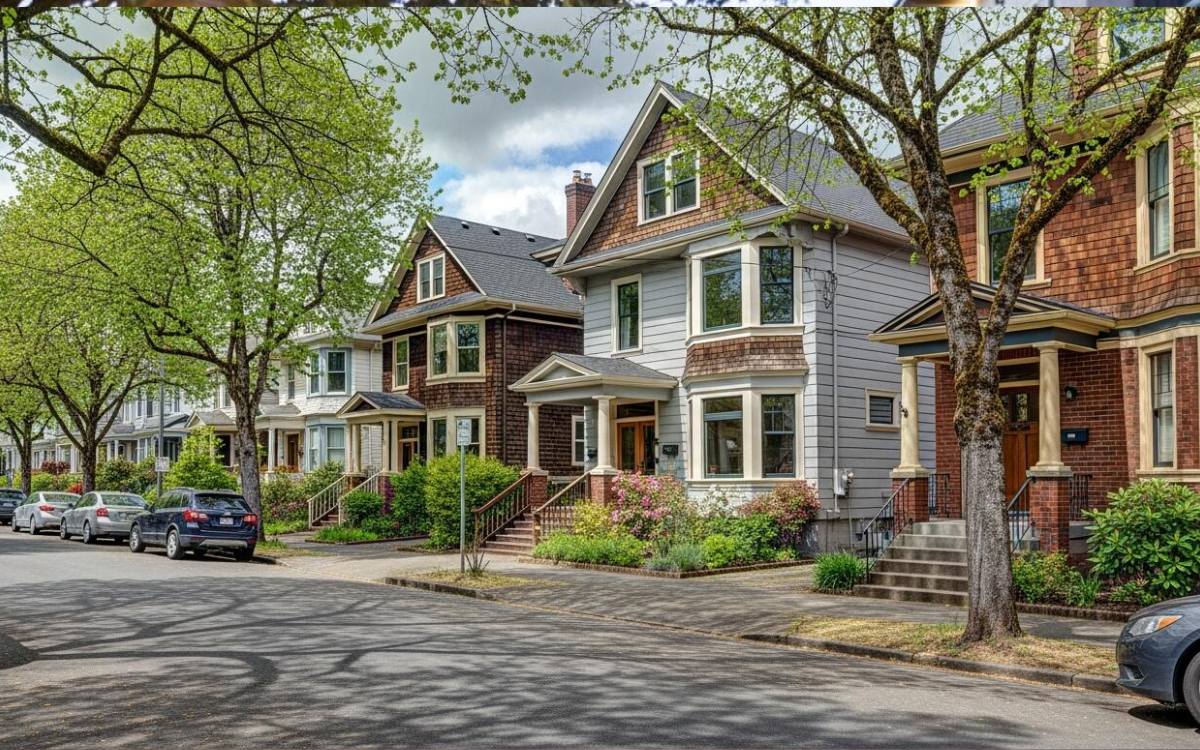
SE Portland is where “Keep Portland Weird” actually lives. When people watch sketch comedies about Portland or imagine the “Keep Portland Weird” slogan, they are usually picturing the vibe of Southeast Portland, specifically around Hawthorne Boulevard. The streets are full of colorful craftsman bungalows, vintage shops, murals, community gardens, and the kind of residents who have strong opinions about coffee and know their neighbors by name.
If you moved to Portland specifically because you wanted somewhere with genuine character and independent spirit — somewhere that hasn’t been homogenized into the same collection of chain stores as everywhere else — SE Portland delivers that more than anywhere else in the city.
3. It’s extremely bikeable
SE Portland has some of the best bike infrastructure in the city, and the flat terrain of inner SE makes cycling genuinely practical for daily life. Most of the main corridors have dedicated bike lanes, and the neighborhood greenways — quiet residential streets with traffic calming specifically designed for cycling — make it easy and safe to get around on two wheels. A lot of SE Portland residents bike to work, to the grocery store, to dinner. It stops feeling like exercise and starts feeling like just how you get places.
4. Housing is more affordable than NE — with more variety
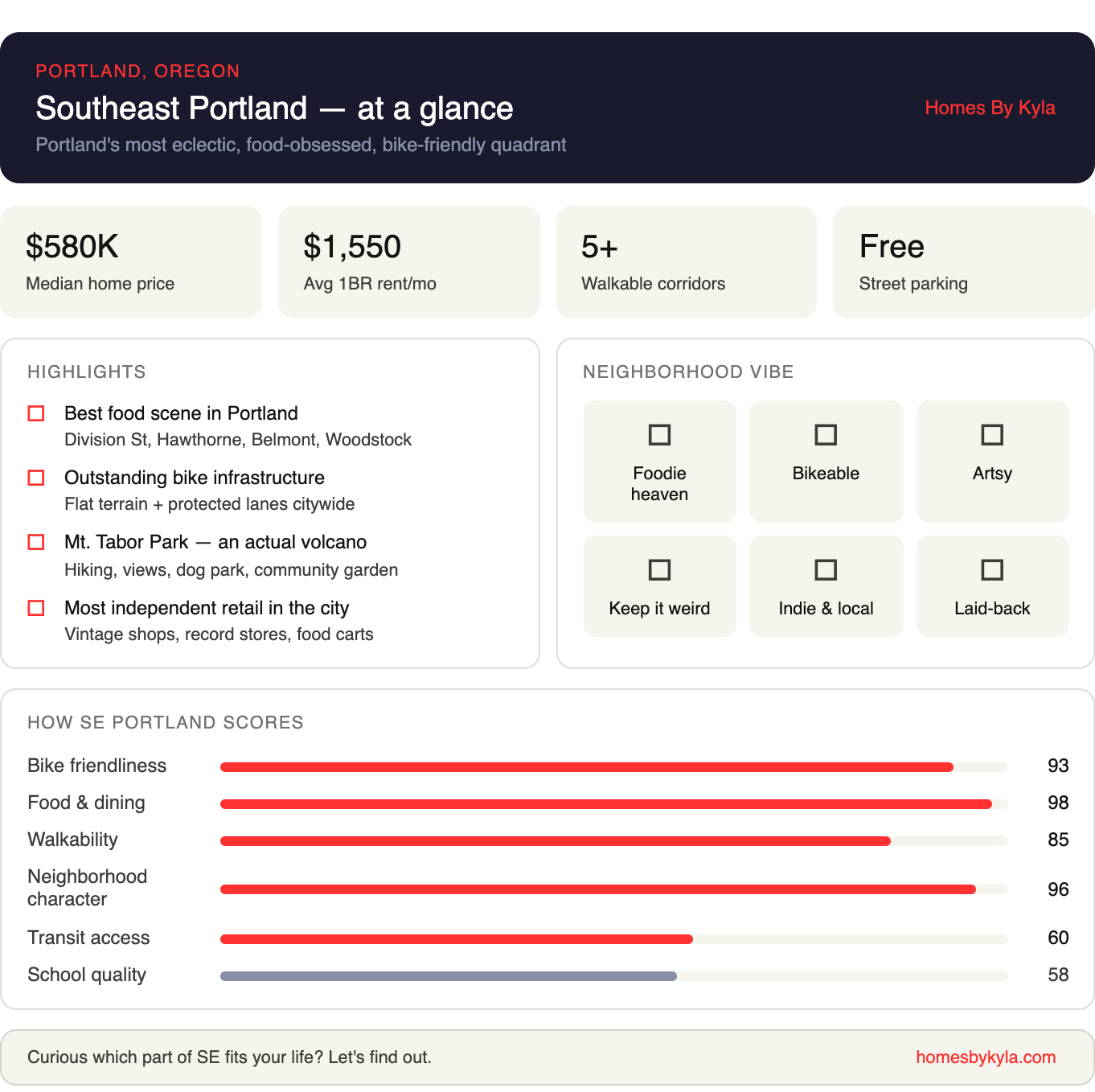
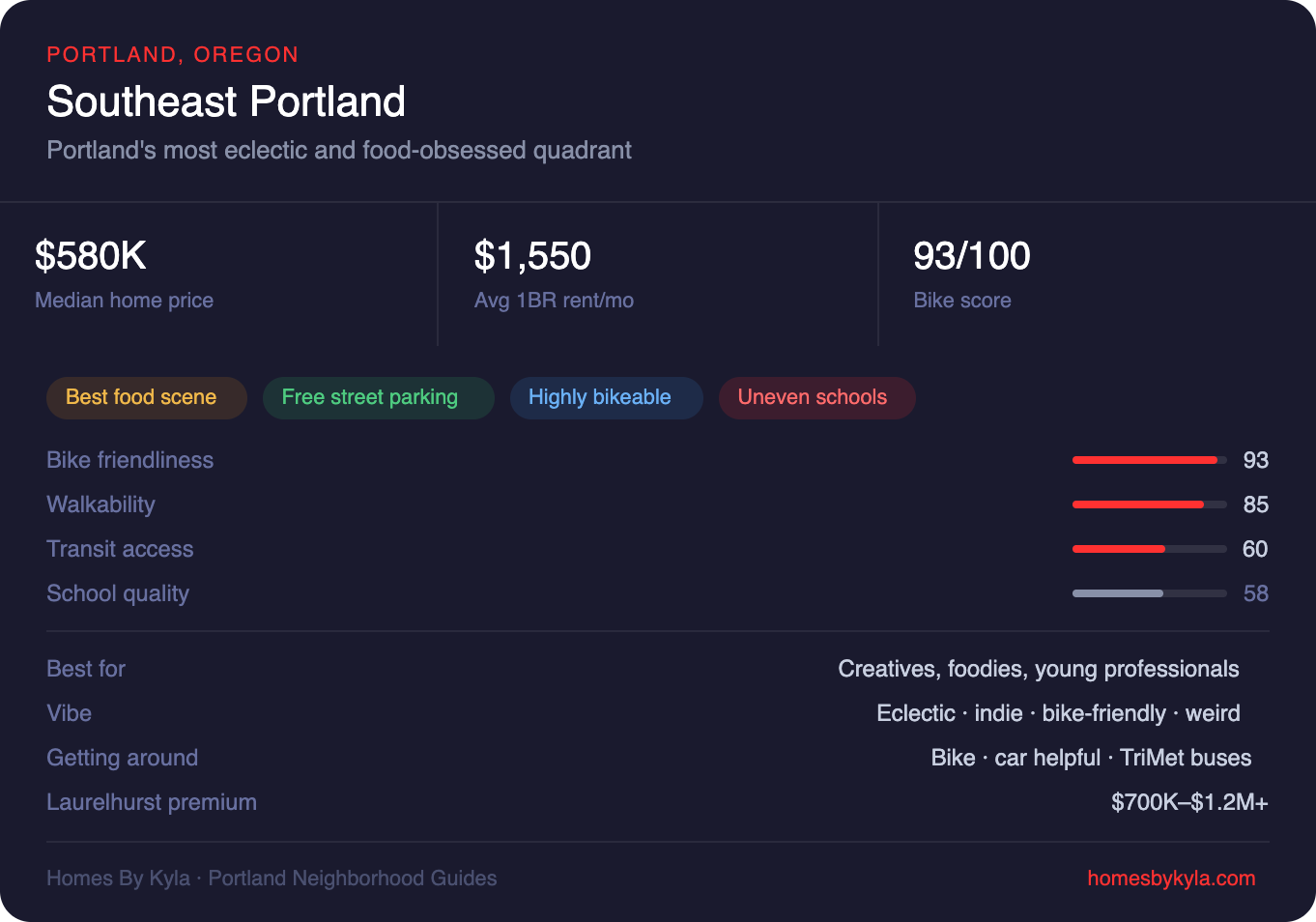
The median home price in Southeast Portland is about $580,000, which is meaningfully lower than NE Portland’s $655,000 overall median and dramatically lower than Irvington’s $915,000. And because SE is so large and varied, the price range is enormous — from the more premium Laurelhurst and Eastmoreland in the $700K–$1.2M+ range all the way down to entry-level options in Foster-Powell and the Jade District starting in the mid-$300Ks.
For buyers who want to be in a walkable, characterful Portland neighborhood without stretching into NE Portland price territory, SE is often the sweet spot.
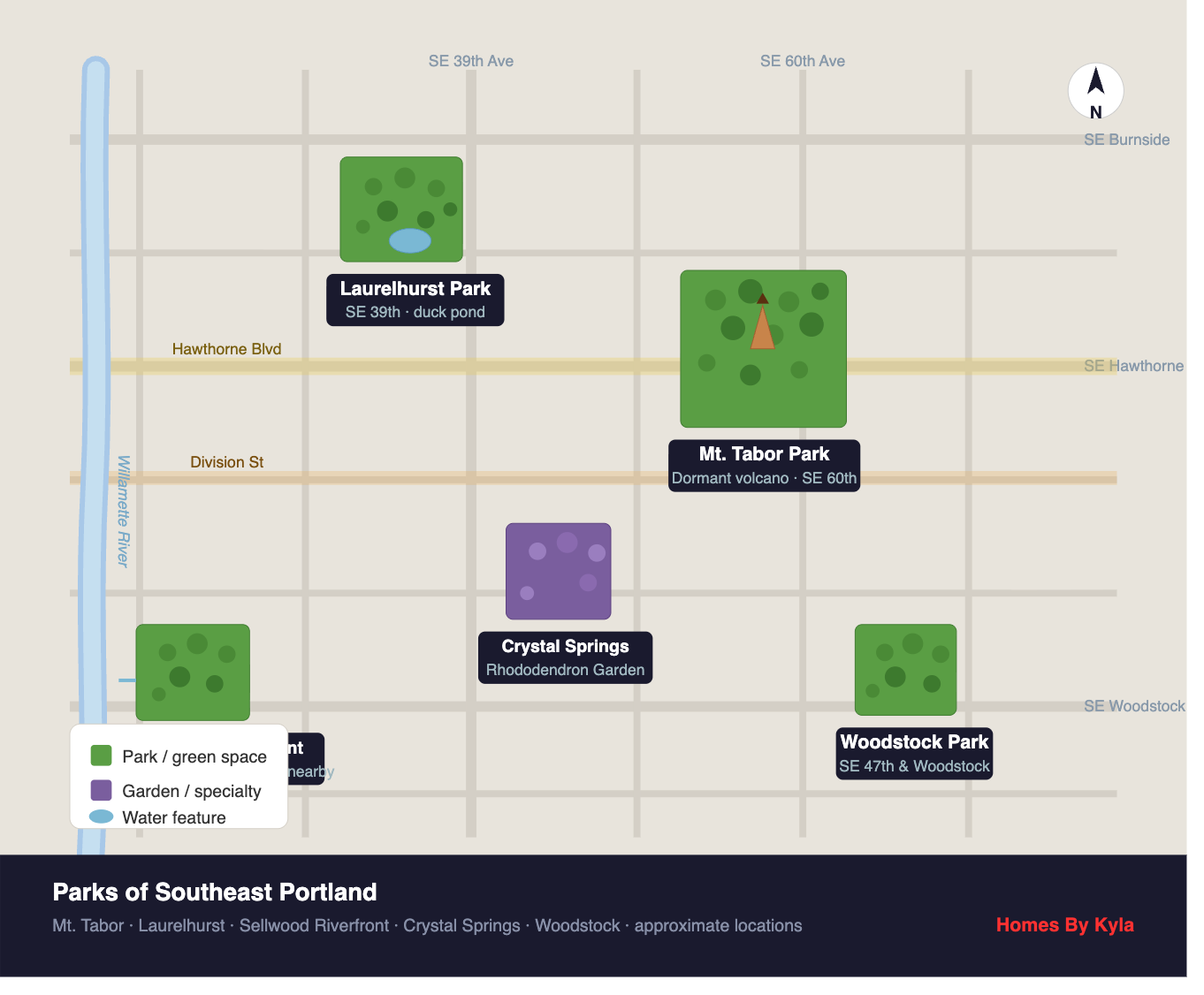
5. Mt. Tabor Park is in your backyard
At the heart of the Mt. Tabor neighborhood lies Mt. Tabor Park, one of Southeast Portland’s largest green spaces. This expansive park has a community garden, dog park, picnic areas, and extensive hiking trails — summit the dormant volcano for breathtaking views of the city, one of the best viewpoints in Portland. Having an actual extinct volcano as your neighborhood park is the kind of thing that only happens in the Pacific Northwest, and it never gets old.
Laurelhurst Park, Sellwood Riverfront Park, and Crystal Springs Rhododendron Garden round out a genuinely exceptional collection of green spaces across the quadrant.
6. Free street parking — actually
SE Portland offers ample free street parking, even near popular spots on Division and Hawthorne. For anyone coming from the Pearl District or Santa Monica where parking is a daily stress, this sounds almost too good to be true. It’s real, and SE residents don’t take it for granted.
The School Districts in Southeast Portland
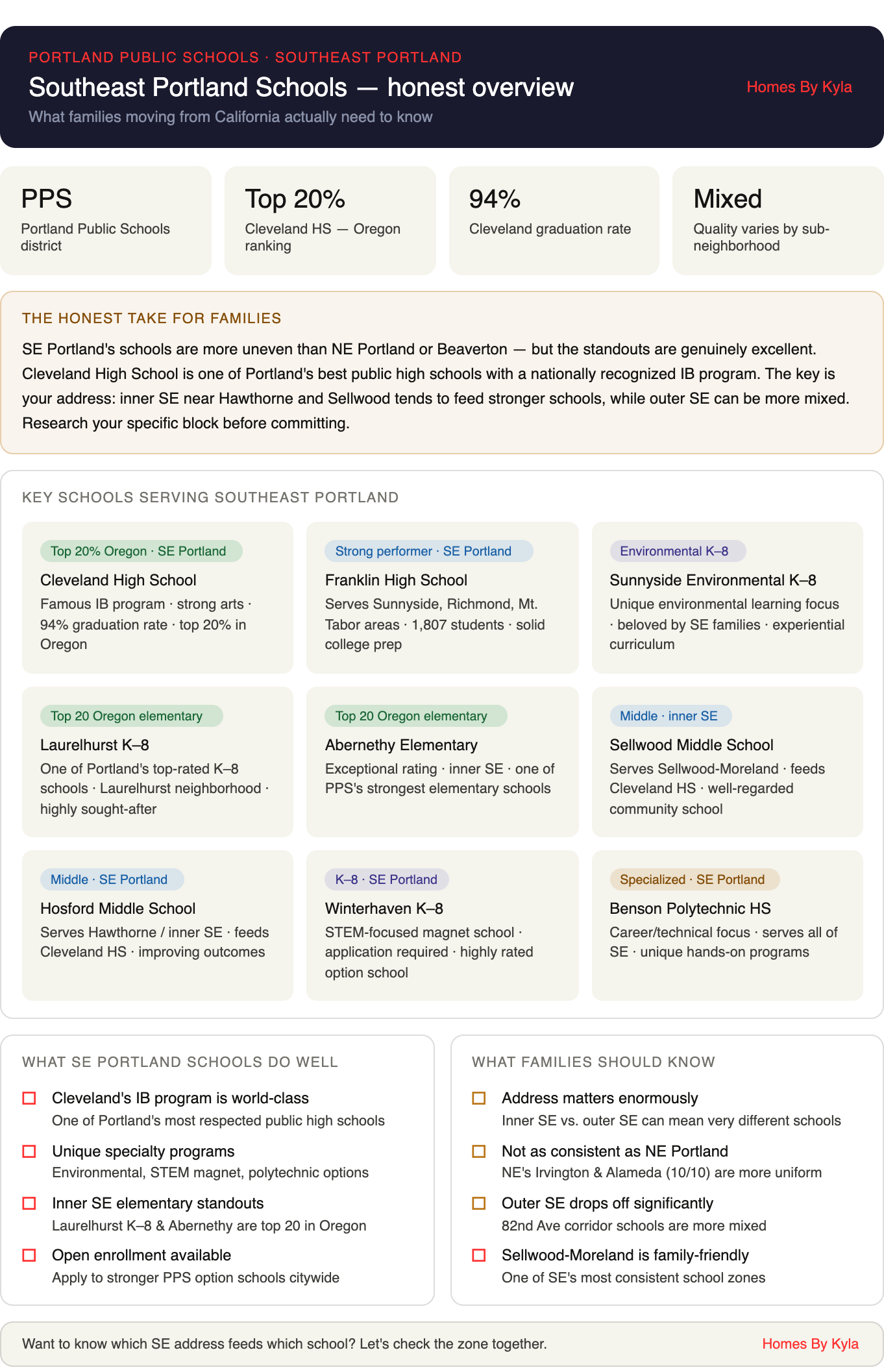
Here’s the thing about SE Portland schools that I always want to be upfront about with families: it’s genuinely a tale of two neighborhoods depending on your address. If you land in inner SE — near Hawthorne, Sellwood, or Laurelhurst — you’re in some of Portland’s best school zones.
Cleveland High School is legitimately one of the strongest public high schools in the city, with a nationally recognized IB program and a 94% graduation rate that beats the Oregon average by thirteen points. Laurelhurst K–8 and Abernethy Elementary both rank in the top 20 elementary schools in Oregon.
But move further east toward the 82nd Avenue corridor and the picture changes meaningfully. The quality gap between inner and outer SE is real, and it matters for families. My strong advice: never assume the school situation based on the neighborhood name alone — always verify the specific address before you make an offer. That’s one of the most valuable things a realtor who knows this market can do for you, and I’m happy to help.
The Cons of Living in Southeast Portland
1. Schools are more inconsistent than NE
Like I mentioned above, this is the biggest trade-off if you’re moving with kids. SE Portland doesn’t have the same concentration of top-rated public schools that makes Irvington and Alameda in NE so compelling for families. There are good options — Sellwood-Moreland and Eastmoreland have solid school reputations — but SE doesn’t have the same lock-in-your-neighborhood-and-know-you’re-set feeling that NE Portland delivers. You’ll want to research specific schools for your address before committing.
2. It’s large and uneven — a lot of homework required
SE Portland covers an enormous area, and not all of it has the same energy or safety profile. The inner neighborhoods — Hawthorne, Division, Belmont, Sunnyside — are wonderful. The outer SE neighborhoods near 82nd Avenue and beyond are more mixed, with higher crime rates and less neighborhood investment. The difference between inner SE and outer SE can feel like two different cities. Do your research on specific blocks before committing to a lease or a purchase.
3. Getting downtown requires a plan
SE Portland is not as seamlessly connected to downtown as the Pearl or even NE Portland. TriMet buses serve the main corridors, but the MAX doesn’t run through most of SE, which means commuting downtown on transit takes longer than you’d expect. Most SE residents end up keeping a car for anything beyond their immediate neighborhood. If you work downtown and are hoping to go car-free, SE is a harder sell than the Pearl or inner NE.
4. It can feel a little too cool for its own good
This is a minor thing, but worth naming — some parts of SE Portland have a vibe that borders on self-consciously quirky. The “Keep Portland Weird” energy is real and great, but there’s a version of it that tips into self-parody. If you’re not a foodie, a cyclist, a vinyl record collector, or someone who has strong opinions about natural wine, you might occasionally feel like you’re missing a password. It’s not unwelcoming — SE Portland is actually very friendly — but the cultural identity here is strong and specific.
5. Noise and foot traffic on the main corridors
Division and Hawthorne are vibrant, which means they’re also busy, noisy, and sometimes crowded on weekends. If you live on or very near one of the main corridors, Friday and Saturday nights are lively. Most people consider this a feature, not a bug — but if you value quiet above everything else, look for a place a few blocks off the main strips.
The Sub-Neighborhoods of Southeast Portland
SE Portland is big enough that where you land makes a big difference. Here’s a quick breakdown:
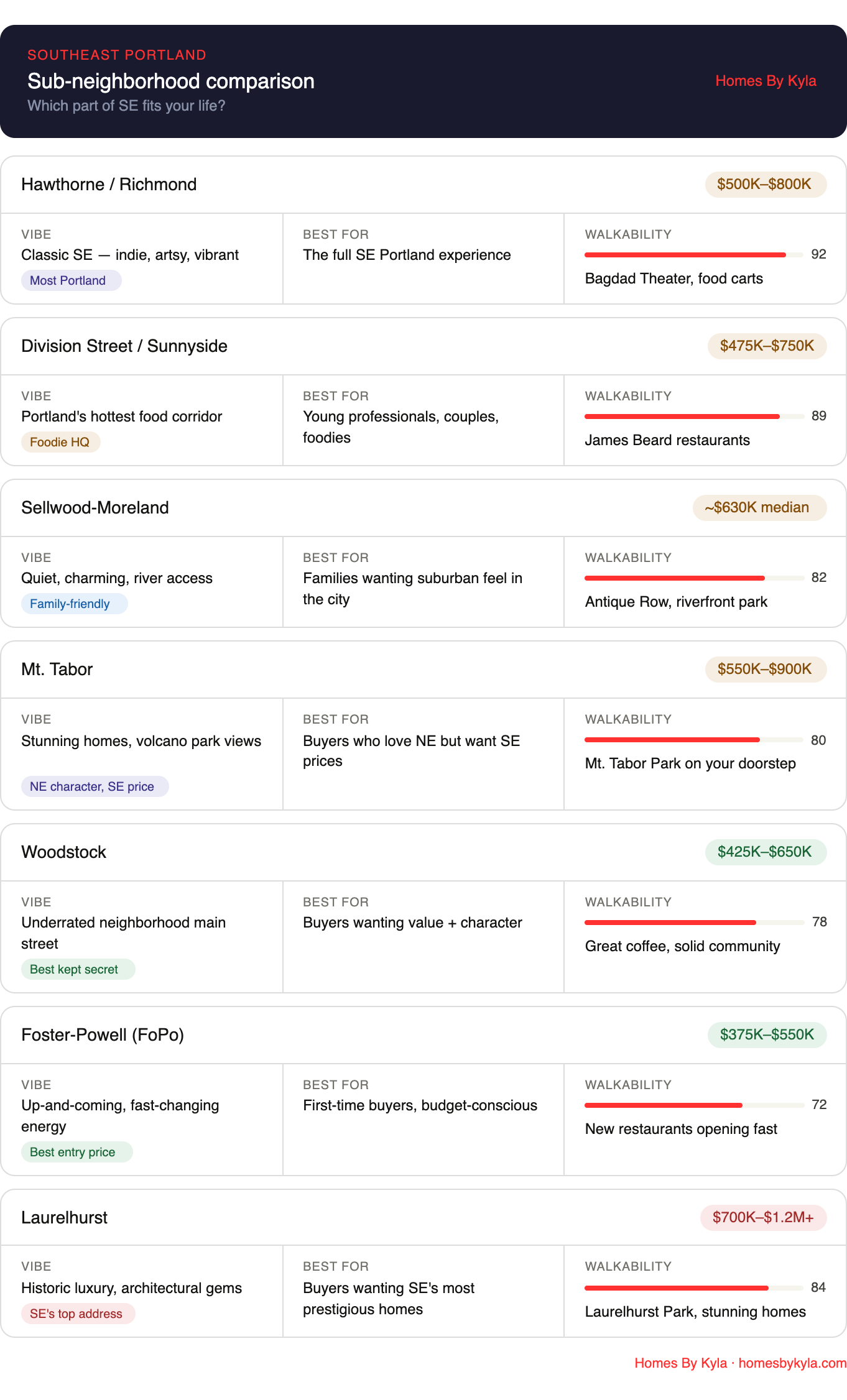
Hawthorne / Richmond — The classic SE experience. Walkable, vibrant, close to everything. Median home prices run $500K–$800K. The Bagdad Theater, incredible restaurants, and some of Portland’s best vintage shopping are all here.
Division Street / Sunnyside — Portland’s most exciting food corridor. Slightly younger energy than Hawthorne, with a mix of craftsman bungalows and newer infill. $475K–$750K range.
Sellwood-Moreland — Ideal for those seeking a quieter, more suburban feel without leaving the city. The area boasts antique shops, locally owned cafés, and scenic views along the Willamette River. It’s among the top family-friendly neighborhoods Portland offers. Median homes around $630K.
Mt. Tabor — Stunning homes, incredible park access, slightly elevated prices. $550K–$900K. A favorite for people who want NE Portland character on the SE side.
Woodstock — Underrated and increasingly popular. A charming neighborhood main street, great coffee, solid value. $425K–$650K range.
Foster-Powell (FoPo) — The up-and-coming option. New restaurants and bars opening constantly, more accessible price points ($375K–$550K), and a community that’s very much in the process of becoming something special.
Laurelhurst — SE’s most prestigious address. Beautiful historic homes, Laurelhurst Park, top-tier architecture. $700K–$1.2M+.
Southeast Portland Quick Stats
- Median home price: ~$580,000 (SE overall); $700K+ in Laurelhurst
- Average 1BR rent: $1,400–$1,700/mo
- Best for: Creatives, foodies, cyclists, young professionals, people who want maximum Portland personality
- Vibe: Eclectic, indie, bike-friendly, food-obsessed, authentically weird
- Getting around: Very bikeable; car helpful for commuting; TriMet buses on main corridors
- Standout parks: Mt. Tabor Park, Laurelhurst Park, Sellwood Riverfront Park, Crystal Springs Rhododendron Garden
Who Is Southeast Portland Right For?
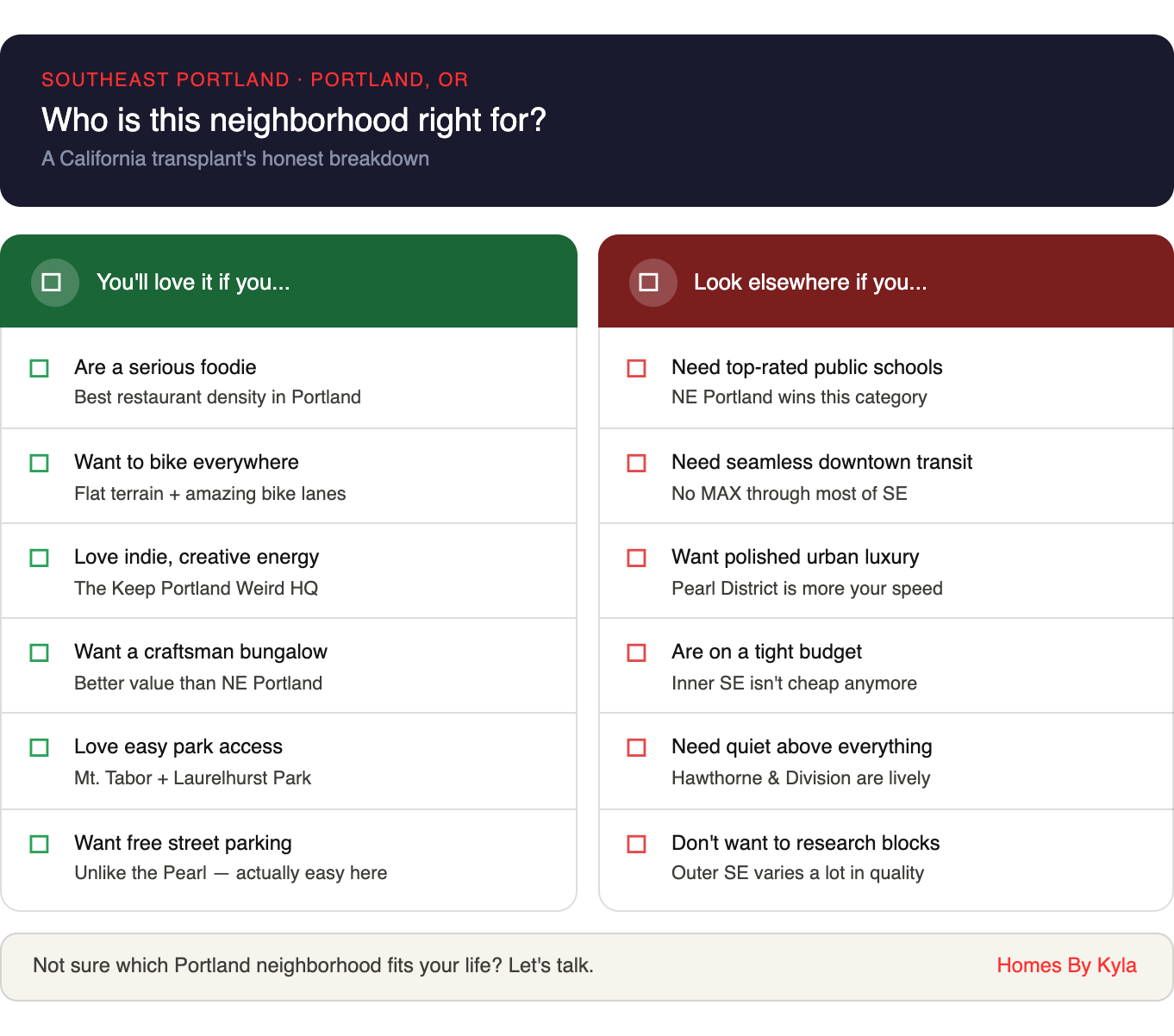
You’ll love SE Portland if you:
- Are a foodie and want to live in the best food neighborhood in the city
- Love independent, eclectic neighborhood energy — the more Portland the better
- Bike or want to bike as your primary mode of transportation
- First time homebuyers wanting to have a house but still in the vibe of a city
- Want a craftsman bungalow with character at a better price than NE
- Are a young professional, creative, or couple without kids
- Moved to Portland specifically for the vibe and want to be right in the middle of it
You might want to look elsewhere if you:
- Have kids and need consistently top-rated public schools
- Work downtown and need seamless transit access
- Want the polished, walkable urban lifestyle of the Pearl
- Are on a tight budget — inner SE isn’t as affordable as it used to be
- Need a quiet neighborhood — the main corridors are lively on weekends
The Bottom Line
Southeast Portland is, for a lot of people, the most fun neighborhood in the city to live in. It has more personality per square block than almost anywhere in the Pacific Northwest. The food alone is worth moving for. And for California transplants who want to feel like they’ve landed somewhere with real culture and real character — not just a nice suburb with good weather — SE Portland delivers that more than anywhere else in Portland.
It’s not the easiest neighborhood for families with school-age kids, and the commute to downtown requires a little more planning than some other parts of the city. But for the right person — and you probably know if you’re that person — SE Portland is going to feel like home faster than you’d expect.
As a Portland realtor who made the move from California myself, I love matching people with the right neighborhood for their actual life. If you’re curious about which part of SE fits your budget and lifestyle, or you want to compare SE to NE before you decide — reach out. That’s genuinely my favorite conversation. 🌲
Curious how North Portland up against other Portland neighborhoods? Check out our guides on living in the Pearl District, Beaverton, Northeast Portland, North Portland & St. Johns— each one is its own whole world.