If you’ve been doing your Portland neighborhood research and you keep seeing North Portland — specifically St. Johns — described as a hidden gem, an up-and-coming neighborhood, or the last place in Portland with the “old Portland” feel, you’re seeing it accurately. This is the part of the city that a lot of people moving from California overlook at first, and then kick themselves for not finding sooner.
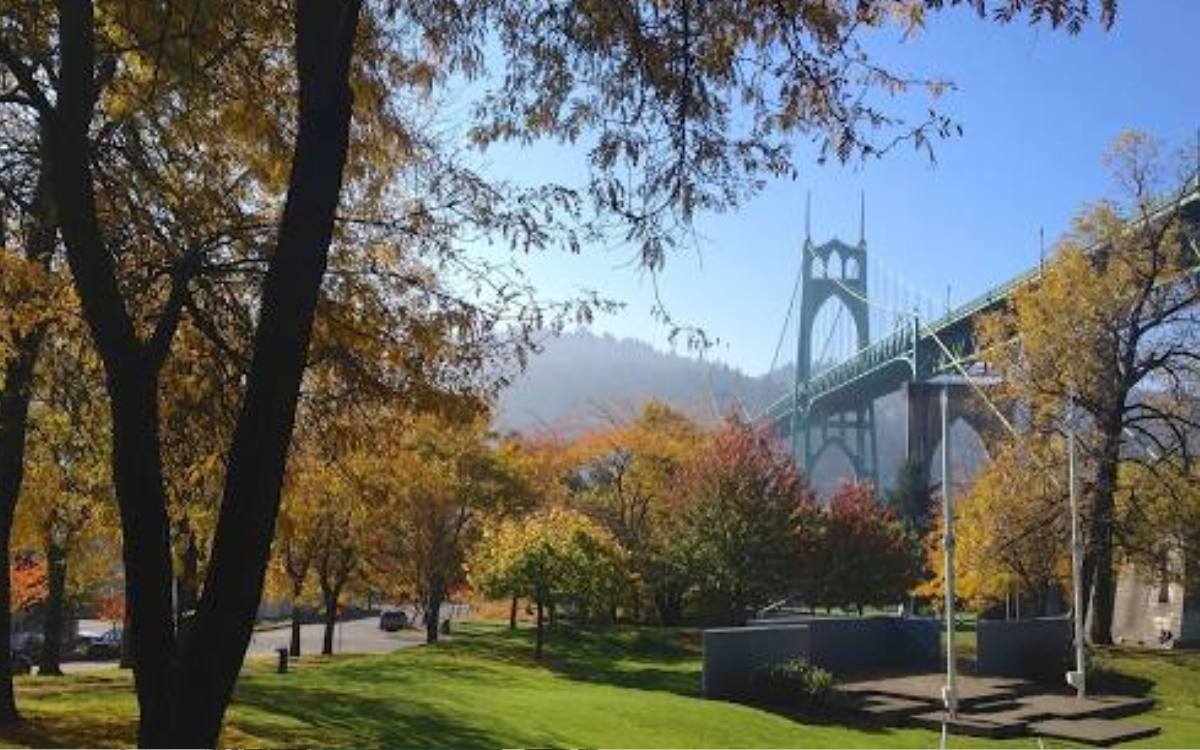
I get it. When I was researching Portland from LA, North Portland wasn’t even on my radar. It felt far. It felt unknown. But here’s the thing about NoPo — once you actually go there, walk down N Mississippi Avenue, grab coffee in St. Johns, stand under the Gothic arches of the St. Johns Bridge at Cathedral Park, you understand immediately why people who land here tend to stay forever.
North Portland is Portland at its most genuine. And in 2026, it might still be the best value left in the city.
What Is North Portland?
North Portland — affectionately called NoPo by locals — is Portland’s so-called “Fifth Quadrant,” a lively patchwork of commercial districts, natural spaces, and residential neighborhoods sitting north of the Pearl District and west of Northeast Portland. It’s home to some of the city’s most charming and distinct neighborhoods: St. Johns, Mississippi Avenue, Williams Avenue, Kenton, Cathedral Park, Overlook, and Arbor Lodge among them.
Quick (and important) clarification — North Portland and Northeast Portland are two completely different neighborhoods, and people mix them up constantly. Northeast Portland (NE) is where you’ll find Irvington, the Alberta Arts District, and those gorgeous craftsman-lined streets that most people picture when they think of “classic Portland.” North Portland sits above NE, on a peninsula formed by the Willamette and Columbia Rivers — it has its own distinct identity, its own main streets, and a totally different feel. NE Portland is the established, slightly pricier choice with top-rated schools. North Portland is the up-and-coming, more affordable option with a small-town soul that NE can’t quite replicate. Both are great — but they’re not the same place, and which one fits you depends a lot on what you’re looking for. If you haven’t read our Northeast Portland guide yet, it’s worth a look too.
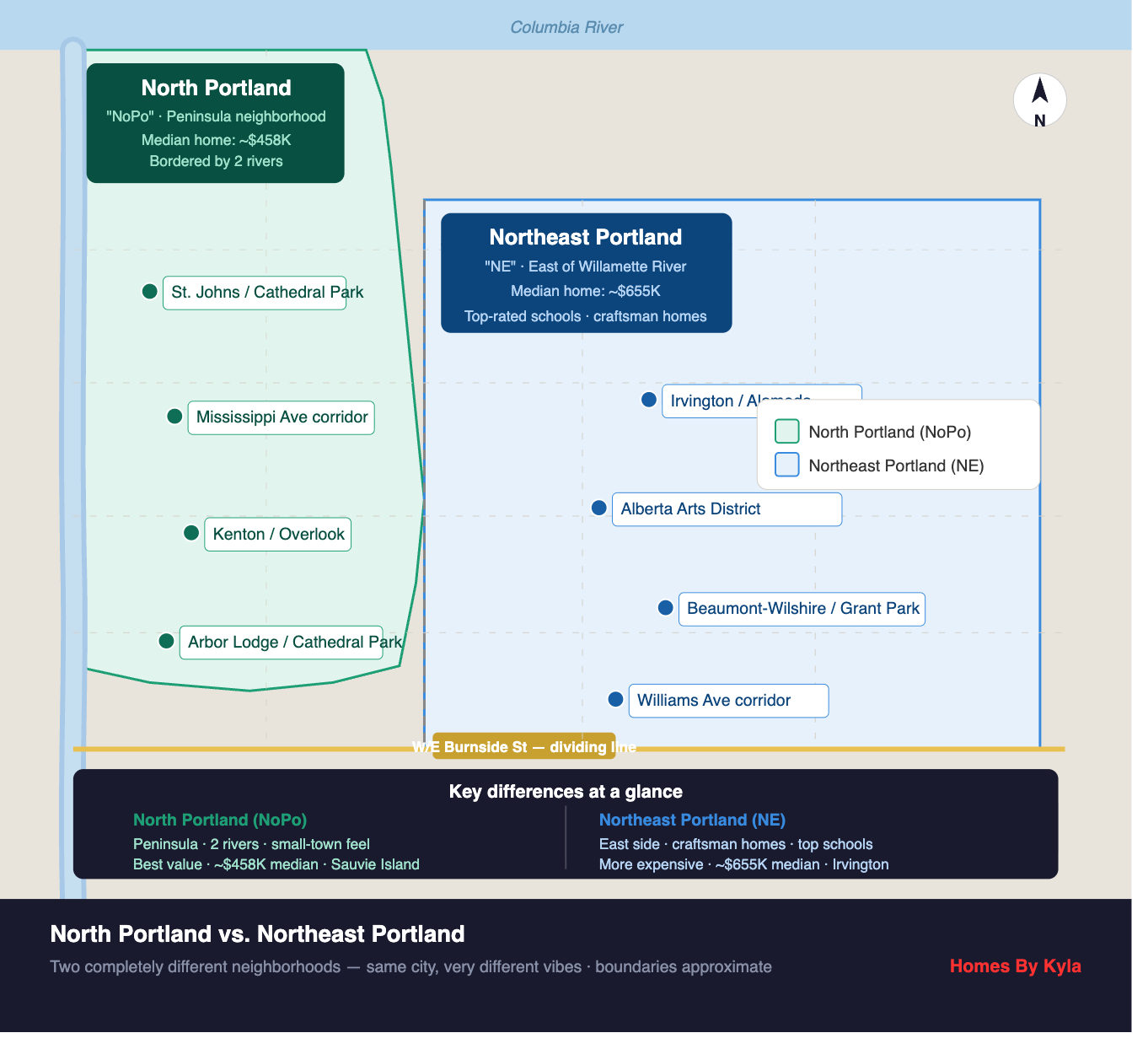
St. Johns sits at the northern tip of the peninsula formed by the confluence of the Willamette and Columbia Rivers, which gives it a genuinely unique geographic identity — it’s a neighborhood literally surrounded by water on two sides, connected to the rest of Portland by the iconic St. Johns Bridge. It doesn’t feel like the rest of Portland. Because of its geographic isolation and the iconic St. Johns Bridge connecting it to the west side, the area has developed a distinct personality — a place where neighbors know each other, the pace is a little slower, and the community pride runs deep.
North Portland is regarded as the land of opportunity. A perfect neighborhood for first time homebuyers. As the city of Portland grew, access to the district improved due to the installment of the MAX Yellow Line in 2004, generating more interest in the neighborhood, with increases in real estate investment, housing demand, and prices following.
The Pros of Living in North Portland
1. The best value left in Portland
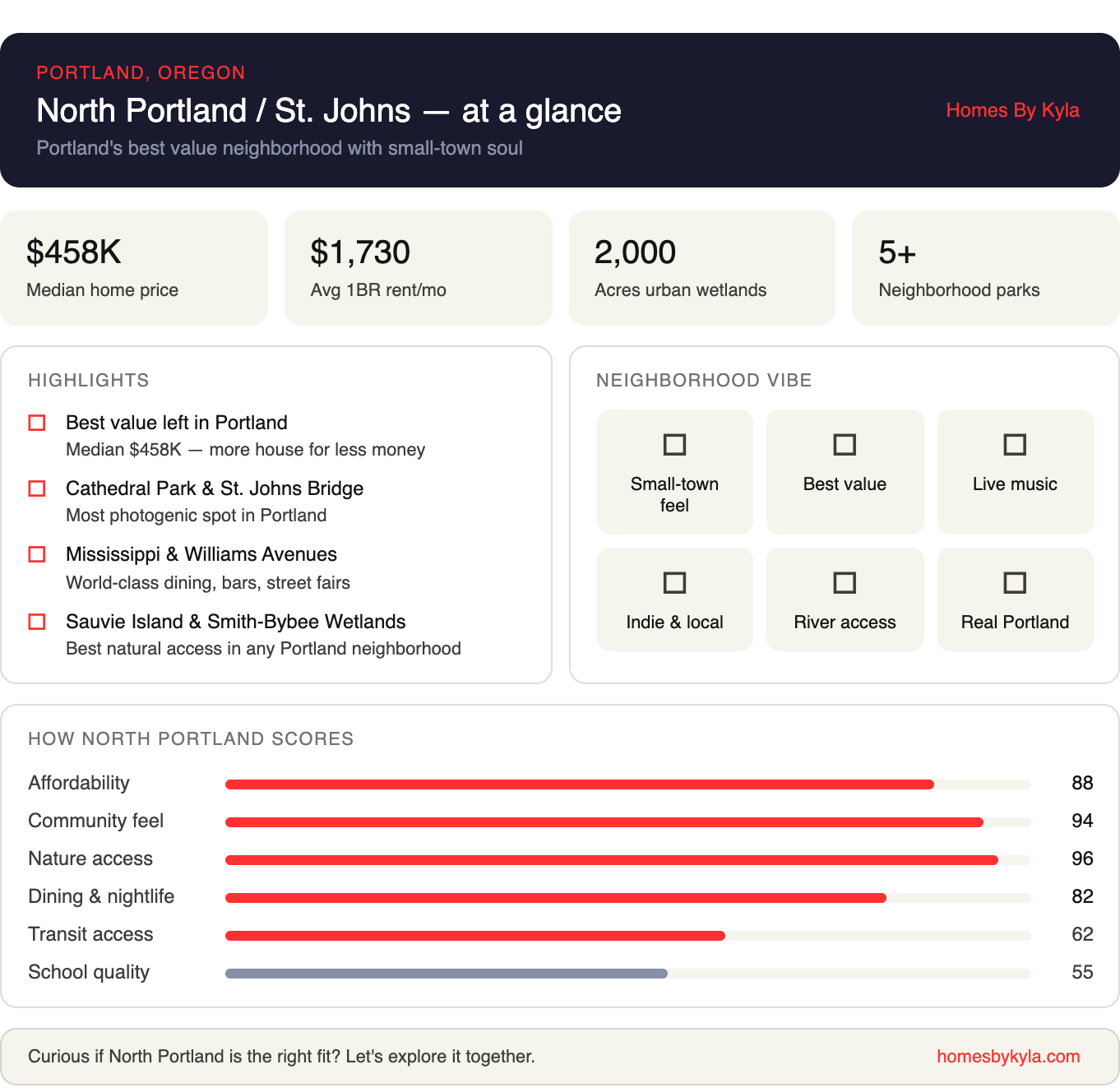
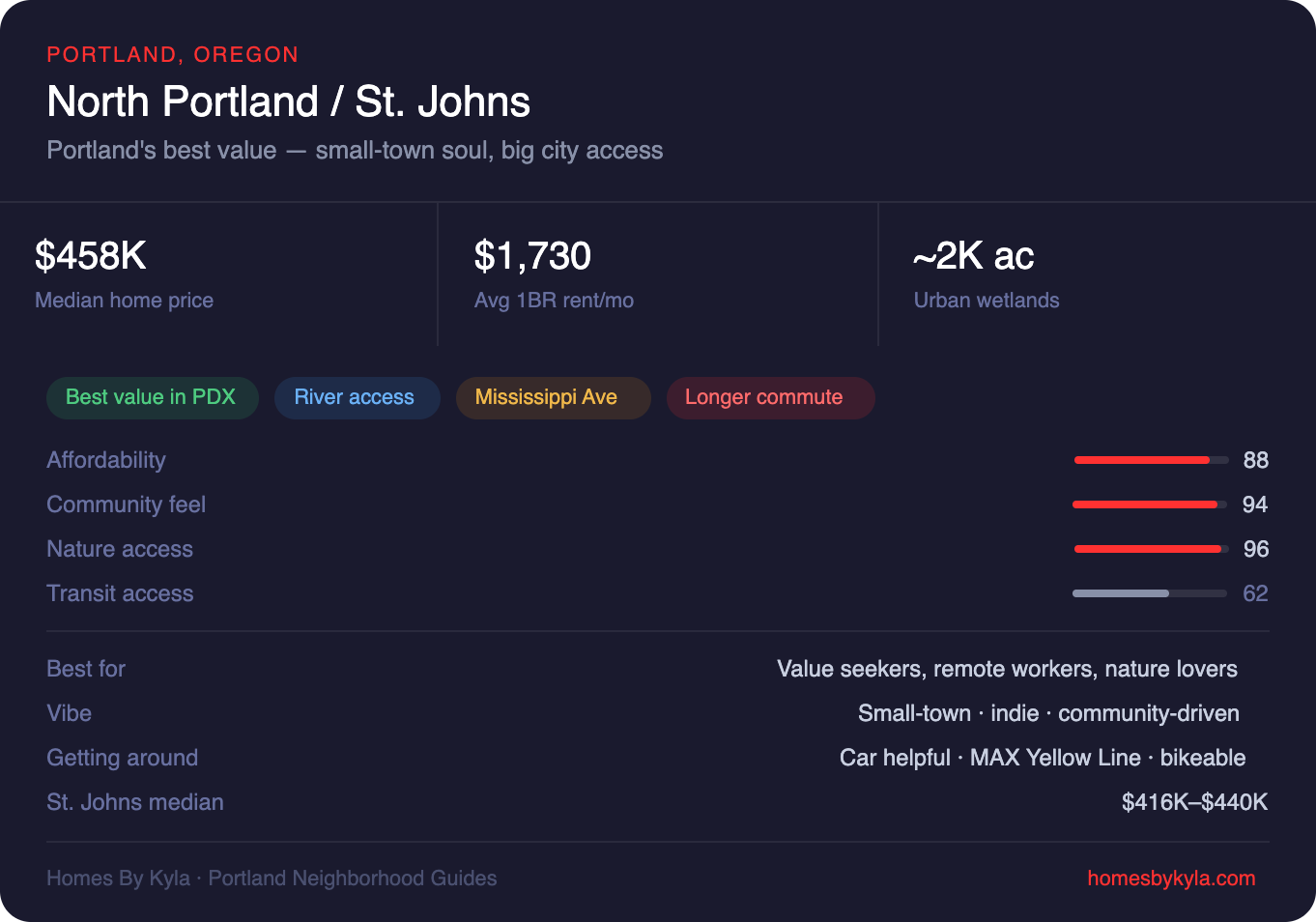
This is the headline. North Portland offers a more accessible median price of $458,327, with an average rent of $1,730 per month — making it significantly more affordable than NE, SE, and of course the Pearl. For California transplants used to paying Bay Area or LA prices, the value here feels almost too good. You can still find a craftsman bungalow with a yard and actual character for under $500,000. That’s increasingly rare anywhere else in Portland.
The trade-off for lower prices is the commute — but for buyers prioritizing space, value, and community over downtown proximity, North Portland is hard to beat.
2. St. Johns is one of the most charming neighborhoods in Portland
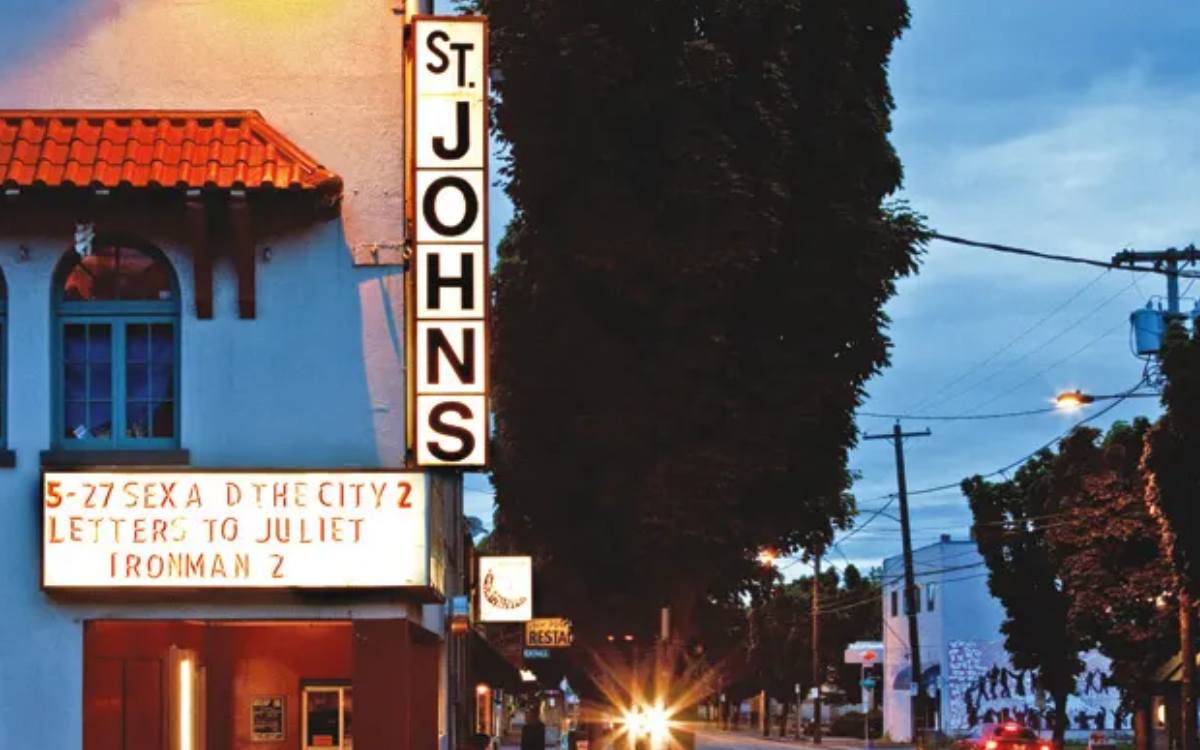
St. Johns has its own downtown — a walkable, historic commercial district centered around N Lombard and N Philadelphia that feels like a genuine small-town main street inside a major city. Independent restaurants, coffee shops, a vintage cinema (the St. Johns Twin Cinema), breweries, and local boutiques line the streets. St. Johns is a great little neighborhood with a great food, music, and entertainment scene. One thing that is very unique about St. Johns is the support for local businesses — many places are family owned and operated, which creates a homey feel.
For Californians coming from cities where everything feels chain-ified and commercial, the fiercely independent spirit of St. Johns is genuinely refreshing.
3. Cathedral Park is one of the most beautiful spots in Portland
Cathedral Park is the postcard shot — located directly under the gothic arches of the St. Johns Bridge, it is famous for photography, summer picnics, and the jazz festival. The Cathedral Park Jazz Festival is a free, three-day celebration that brings music enthusiasts to the green space every mid-July — the longest-running jazz and blues festival west of the Mississippi River.

A new floating dock opened in 2024, adding river swimming and watercraft access to what’s already one of the most photogenic parks in the Pacific Northwest. Standing under those Gothic bridge arches with the Willamette in front of you and the city behind you is one of those Portland moments that makes you feel like you made exactly the right choice.
4. Mississippi and Williams Avenues are world-class
N Mississippi Avenue is one of Portland’s great commercial streets — the Mississippi Street Fair is the largest of Portland’s many street fairs, blocking off much of North Mississippi Avenue and creating a pedestrian’s paradise with homemade goods, food, and multiple stages of music every July. The street itself is lined with excellent independent restaurants, bars, coffee shops, vintage stores, and the kind of great 1920s architecture that makes Portland so photogenic.
N Williams Avenue runs parallel and is equally beloved — a cycling corridor lined with restaurants, breweries, and community spaces that has become one of NoPo’s most vibrant stretches. Together, Mississippi and Williams give North Portland a dining and nightlife scene that rivals anywhere else in the city.
5. Incredible access to nature & parks
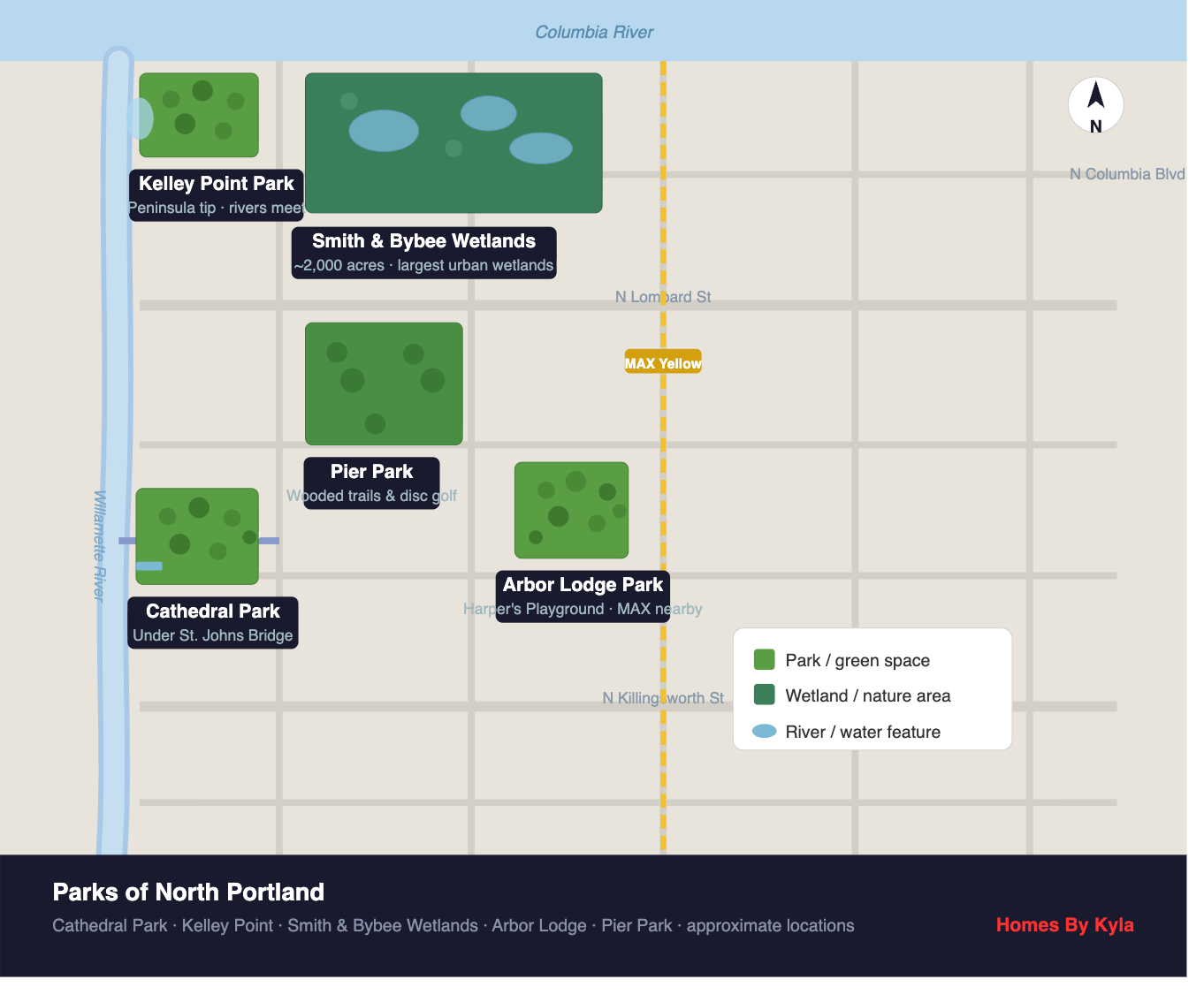
North Portland is home to the Smith and Bybee Wetlands Natural Area, which at nearly 2,000 acres is among America’s largest urban wetlands. Kelley Point Park sits at the very tip of the peninsula where the Willamette and Columbia Rivers meet — one of the most unique outdoor spaces in any American city. Just a little north on Highway 30 is Sauvie Island, a wonderful place with farms, beaches, and bike paths extending between the Columbia River and the Columbia Slough, all the way out to St. Helens. You can pick pumpkins in October, swim in the river in August, and hike through wetlands year-round — all within 15 minutes of home. There’s some awesome parks for you and your pups, too!
6. The MAX Yellow Line connects you to downtown
The MAX Yellow Line runs through North Portland, connecting neighborhoods like Kenton and Mississippi/Albina directly to downtown Portland. A trip to downtown Portland is about a 15-minute drive or 30-minute bike ride from most of NoPo — longer than the Pearl or NE, but very manageable, especially with transit.
7. University of Portland is here
The University of Portland sits in North Portland’s Bluff neighborhood, which adds a steady, educated community energy to the area. It’s also a practical note for anyone with college-age kids or who works in higher education.
The Cons of Living in North Portland
1. The commute is real
Let’s be honest about this upfront. North Portland — especially St. Johns — is farther from downtown than the Pearl, NE, or SE. While the MAX Yellow Line helps, St. Johns itself isn’t on the MAX, meaning you’re relying on buses or a car for that last stretch. If you work downtown and commute daily, the extra 10–20 minutes each way adds up. For remote workers or people who commute infrequently, it’s a total non-issue. But it’s worth knowing.
2. Some parts are still transitional
North Portland has improved dramatically over the past decade, but it’s large and uneven. Some streets are beautifully revitalized; others are still works in progress. Property crime rates are higher in some NoPo pockets than in NE or SE’s inner neighborhoods. As with any up-and-coming area, do your research on specific streets and blocks before committing — the gap between the best and worst blocks can be significant.
3. Fewer luxury amenities
If you’re coming from Santa Monica or the Pearl District and you need hotel-quality building amenities, rooftop pools, or sleek high-rise living, North Portland isn’t going to scratch that itch. The housing here is craftsman bungalows, foursquares, and modest historic homes. The neighborhood energy is community and local business, not polished urban luxury. For most people who end up here, that’s exactly the appeal — but know what you’re signing up for.
4. N Lombard can be scrappy
N Lombard Street, the main east-west artery through North Portland, is a busy, commercial corridor that isn’t the prettiest stretch of road. It’s functional and improving, but it’s not the picturesque main street that Hawthorne or Alberta are. The better vibes in NoPo are found on the side streets and specifically on Mississippi, Williams, and in St. Johns’ own neighborhood center a few blocks north.
5. Less walkable overall
Outside of the specific commercial corridors — Mississippi, Williams, and St. Johns’ downtown — North Portland is more car-dependent than inner NE or SE. Daily errands may require driving if you’re not within walking distance of a main strip. That said, bikeability is excellent along Williams and Mississippi, and the neighborhood greenways make cycling very practical.
The Sub-Neighborhoods of North Portland
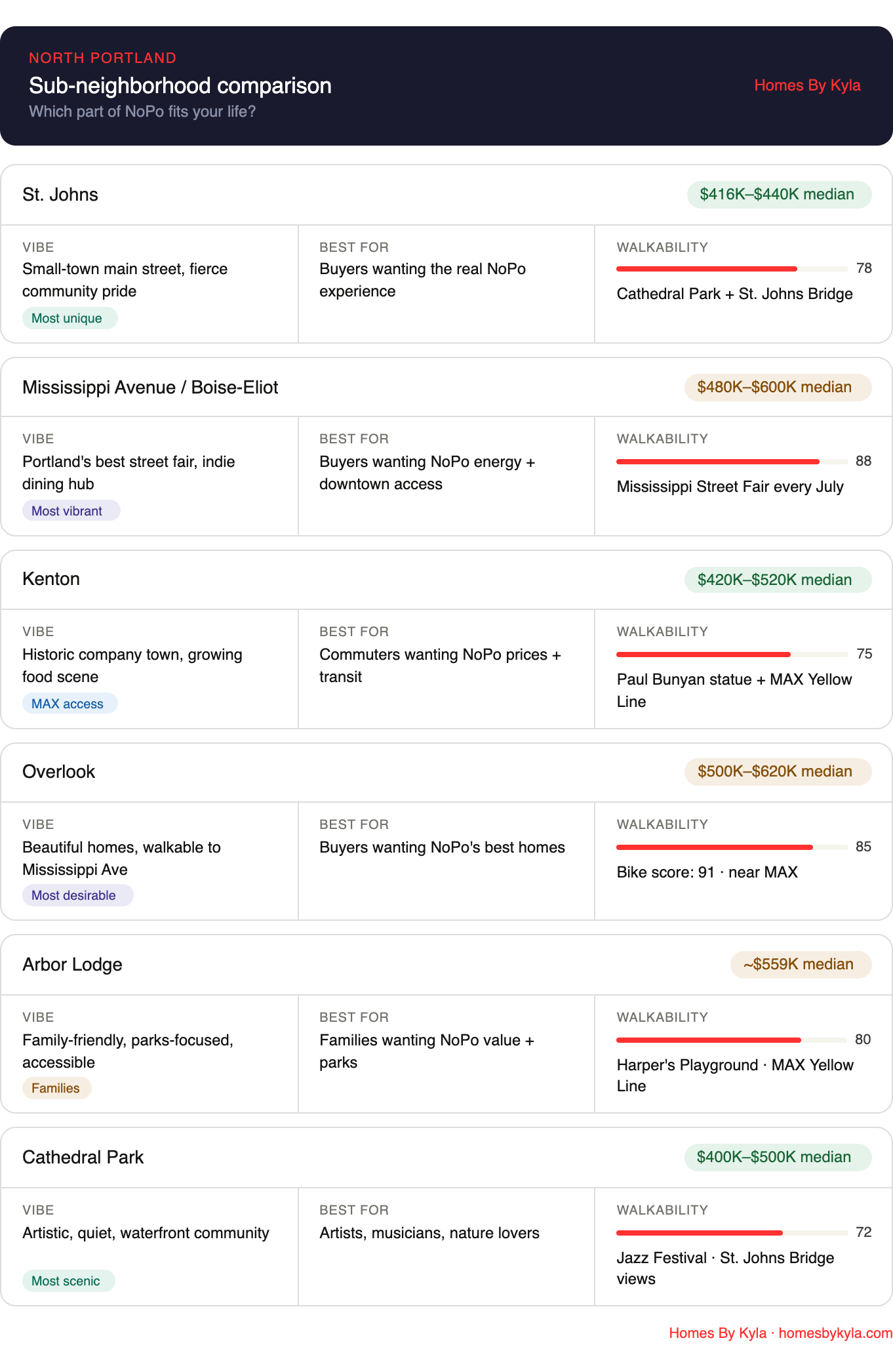
St. Johns — The heart of it all. Historic downtown feel, Cathedral Park, the St. Johns Bridge, fierce community pride. Median home prices around $416K–$440K. The most talked-about sub-neighborhood in NoPo.
Mississippi Avenue / Boise-Eliot — Portland’s most vibrant street fair neighborhood. Excellent restaurants, bars, and walkability. Closer to downtown than St. Johns, with some of NoPo’s best transit access. More expensive than St. Johns but still strong value.
Kenton — A historic company town turned cool neighborhood. N Denver Avenue has a growing dining and bar scene, a community feel, and the famous 31-foot Paul Bunyan statue. Kenton is home to the Kenton/N. Denver Avenue MAX station, making downtown access easy. Great value.
Overlook — One of NoPo’s most desirable sub-neighborhoods. Beautiful homes, walkable to Mississippi Avenue, excellent bike scores. Slightly higher prices than the rest of NoPo but still well below NE and SE comparables.
Arbor Lodge — Family-friendly, with great parks (including Harper’s Playground, a universally accessible playground). Median sale prices around $559,500, up significantly year over year, reflecting strong demand. MAX Yellow Line access.
Cathedral Park — The neighborhood immediately under the St. Johns Bridge. Walkable to St. Johns, quiet residential streets, and of course the park itself. Tight-knit, artistic community energy.
North Portland School Districts
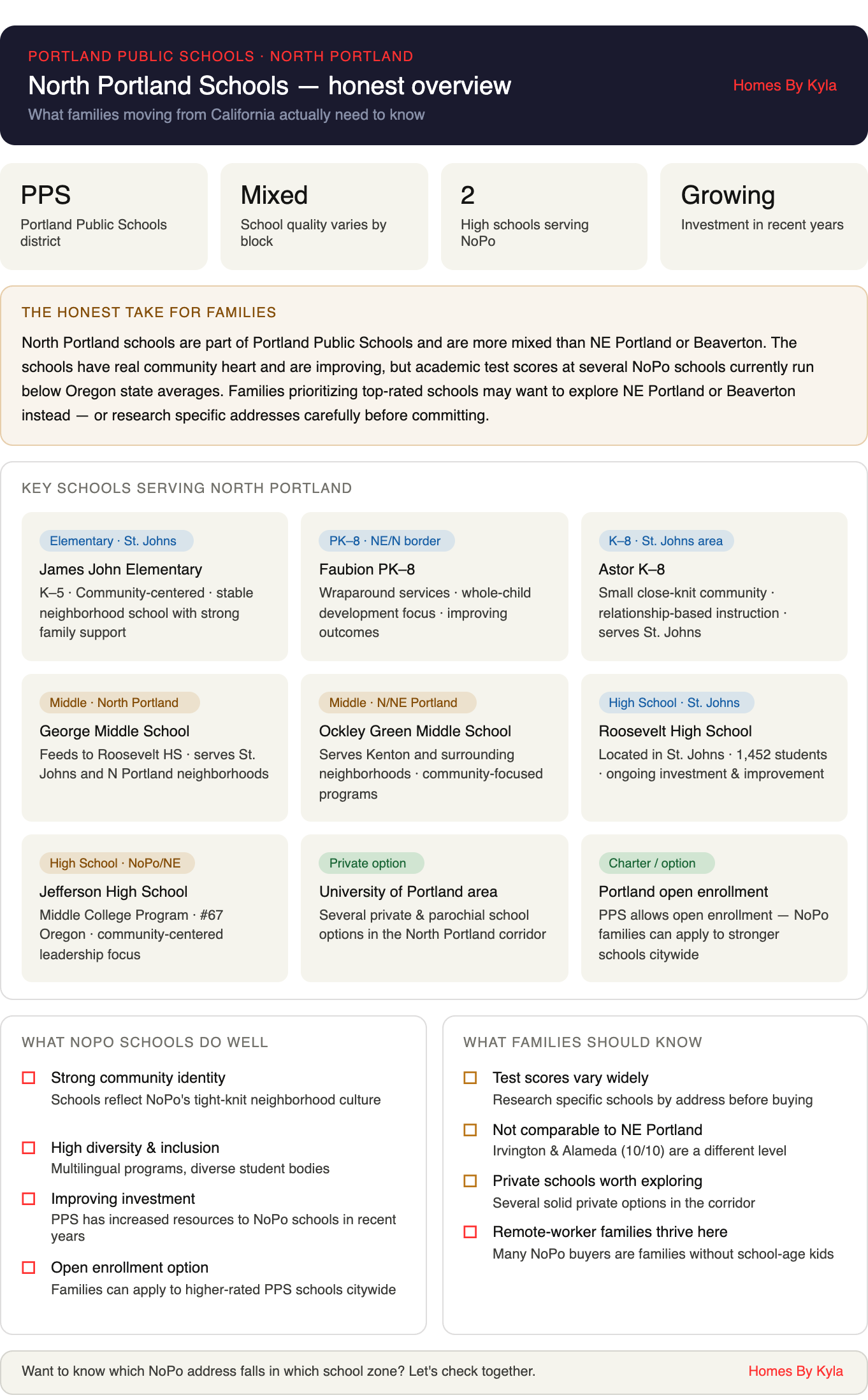
One thing I always want to be upfront about with families considering North Portland: the schools here are more mixed than what you’ll find in NE Portland or Beaverton, and that’s worth knowing before you fall in love with a house.
North Portland is part of Portland Public Schools, and while the neighborhood has real community heart and schools have seen increased investment in recent years, academic performance at several NoPo schools currently runs below Oregon state averages.
That said, it’s not a dealbreaker for everyone — Portland Public Schools allows open enrollment, which means you can apply to higher-rated schools anywhere in the district regardless of where you live. And honestly, a lot of the families who end up thriving in North Portland are remote workers, couples, or people whose kids are grown — they’re here for the value, the community, the outdoor access, and the vibe. If school ratings are your top priority though, I’d point you toward NE Portland or Beaverton first.
And if you’re somewhere in the middle, reach out — the right address in NoPo can make a real difference, and that’s exactly the kind of local knowledge I’m here for.
North Portland Quick Stats
- Median home price: ~$458,000 (NoPo overall); $416K–$440K in St. Johns
- Average 1BR rent: ~$1,730/mo
- Best for: Value seekers, community-oriented buyers, remote workers, nature lovers, people who want the “real Portland” feel
- Vibe: Small-town within a big city, independent, community-driven, artsy, unpretentious
- Getting around: Car helpful; MAX Yellow Line through Kenton/Mississippi; very bikeable on Williams corridor
- Standout parks: Cathedral Park, Kelley Point Park, Smith & Bybee Wetlands, Arbor Lodge Park, Pier Park
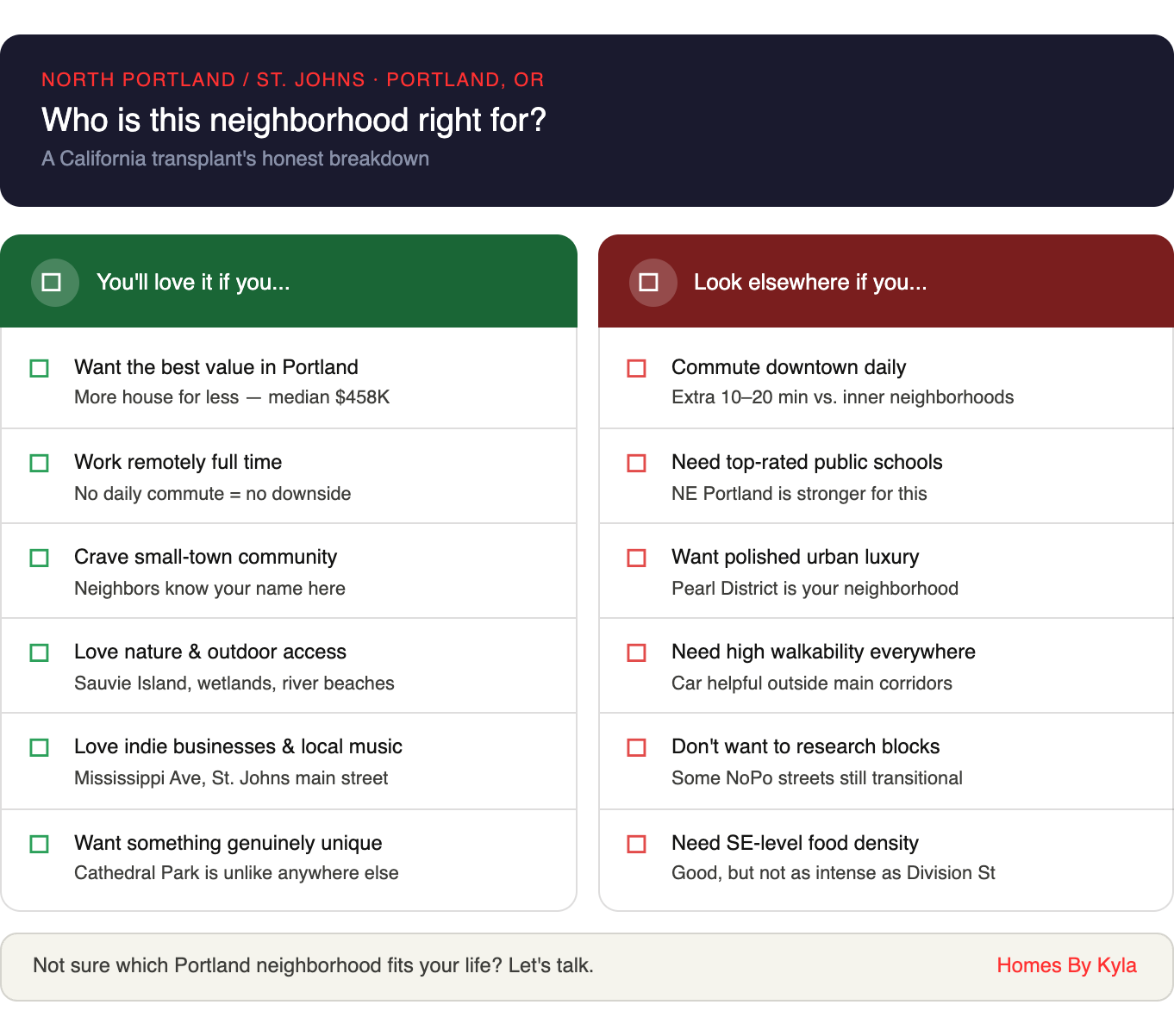
Who Is North Portland Right For?
You’ll love North Portland if you:
- Want the best value left in Portland — more house for less money
- Crave a genuine small-town community feel inside a city
- Work remotely and don’t need a daily downtown commute
- Love independent restaurants, local music, and neighborhood culture
- Want incredible outdoor access — wetlands, river beaches, Sauvie Island
- Are looking for a neighborhood with real character that hasn’t been fully gentrified yet
You might want to look elsewhere if you:
- Need to commute downtown daily and want to minimize transit time
- Require the walkability and density of inner SE or the Pearl
- Have kids and school quality is your top priority — NoPo schools are more mixed than NE
- Want polished urban luxury and high-end amenities
- Need to be close to Portland’s main employment centers
The Bottom Line
North Portland — and St. Johns in particular — is one of those neighborhoods that rewards the people curious enough to explore it. It’s not as immediately obvious as the Pearl or as well-known as NE Portland’s Irvington, but for the right person it offers something those neighborhoods genuinely can’t: affordability, authenticity, community, and some of the most stunning natural access of any neighborhood in the city.
For California transplants who are tired of paying premium prices for less space and less soul, North Portland is a genuine revelation. The commute is a little longer. The neighborhood is still evolving. But the people who land here — and there are more of them every year — tend to look at each other and say: “Why didn’t we find this sooner?”
As a Portland realtor who made this move from California myself, North Portland is one of my favorite neighborhoods to introduce to buyers. If you want to explore what NoPo could look like for your life — reach out. I’d love to show you around. 🌲
Curious how North Portland up against other Portland neighborhoods? Check out our guides on living in the Pearl District, Northeast Portland, Southeast Portland, Beaverton and North Portland & St. Johns— each one is its own whole world.