If you’re sitting in California right now doing mental math on what life would look like up here, I get it — I did the exact same spreadsheet a few years back. So let’s skip the vague “it’s more affordable!” hand-waving and actually talk numbers. This is the real Portland cost of living vs California breakdown, based on what I see every day helping people make this move.
I made the jump myself — a decade in LA between Burbank, Redondo Beach, and Santa Monica before coming home to Oregon — so I’ve lived both sides of this comparison personally, not just professionally.
The Quick Answer
Yes, Portland is meaningfully cheaper than most of California — especially the Bay Area and LA. But it’s not a blanket “everything costs less” situation. Some things are a wash. A few things actually cost more. Here’s where your money goes further, and where it doesn’t.
Housing: This Is Where the Real Savings Live
Let’s start with the big one, because housing is where the Portland cost of living vs California gap is the widest.
| Category | California (Bay Area / LA) | Portland, OR |
|---|---|---|
| 1BR apartment (rent) | $2,500–$3,800/mo | $1,400–$1,900/mo |
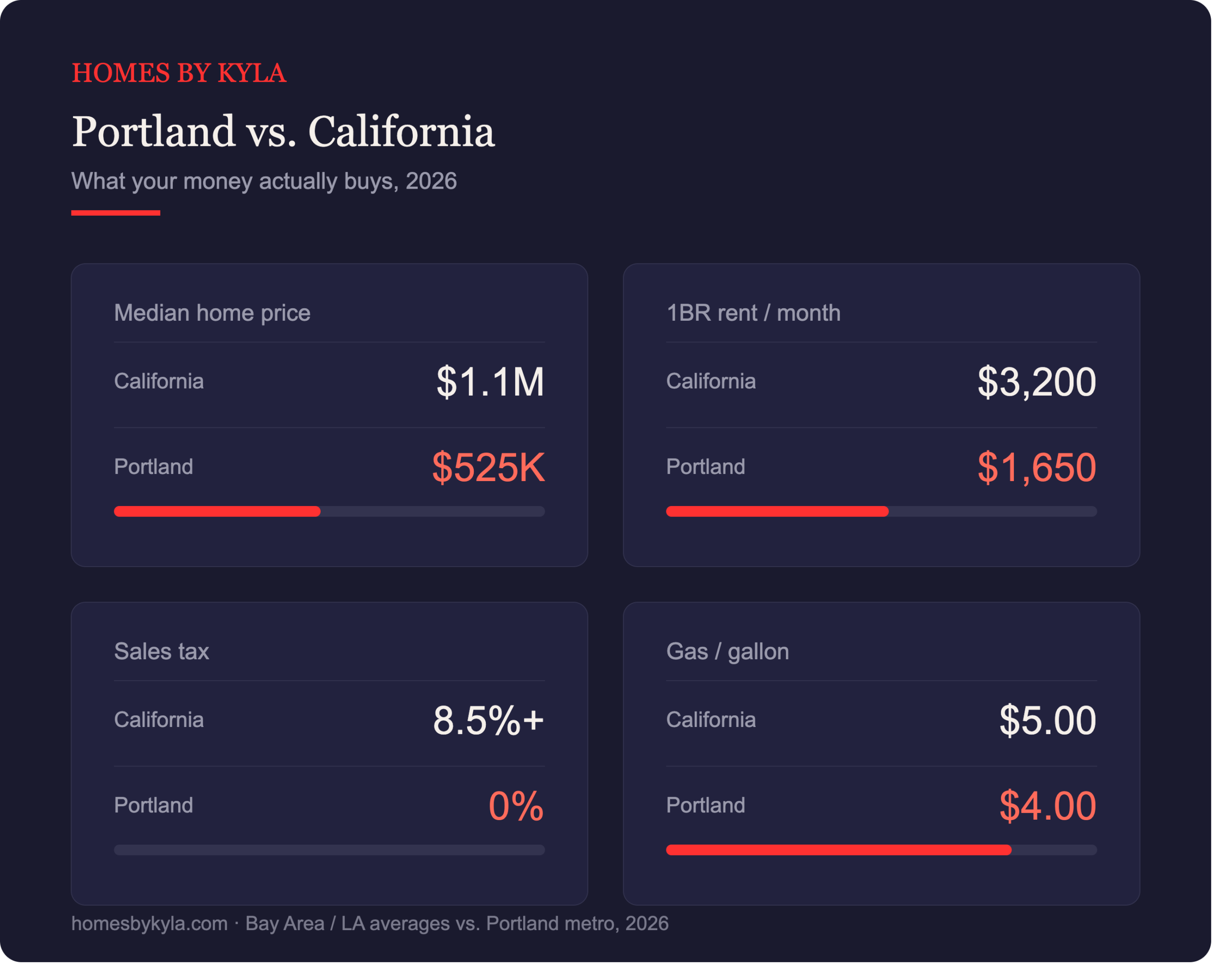
| Median home price | $900K–$1.4M+ | $450K–$600K |
| Price per sq ft (avg) | $700–$1,100+ | $300–$400 |
That median home price gap alone is often a $400K–$700K difference. For a lot of my clients, that’s the difference between renting forever in California and actually owning something here — sometimes with a yard, sometimes with room to grow into.
It’s worth saying: Portland isn’t the bargain it was ten years ago. Prices have climbed. But compared dollar-for-dollar against LA or the Bay Area, your housing budget stretches dramatically further here.
Taxes: A Mixed Bag (Read This Part Carefully)
This is the category people get wrong the most, so let’s slow down.
Sales tax: Oregon has zero sales tax. Not “low” — zero. You see the price on the tag, you pay that price. If you’re used to California’s 7.25–10.75%, this alone adds up fast, especially on big purchases like furniture or a car.
Income tax: Here’s the catch — Oregon’s income tax is actually higher than people expect, topping out at 9.9% for high earners. California’s top rate is higher on paper (13.3%), but it only kicks in at very high income levels. For a lot of middle-to-upper income earners, the income tax difference between the two states is smaller than you’d think.
Property tax: Oregon’s property tax rates are moderate, but because home values (and therefore tax bills) are so much lower here, your actual annual property tax bill is usually well below what you’d pay in California on a comparably “nice” home.
The honest takeaway: don’t assume Oregon is a tax haven. Run your specific numbers — income level, homeownership plans, spending habits — before assuming massive tax savings. The real win is almost always on the housing side, not the tax side.
Everyday Costs: Groceries, Gas, Utilities
This is where things start to even out a bit:
- Gas: $3.50–$4.50/gallon in Portland vs. $4.50–$5.50 in California — a real but smaller gap than housing
- Groceries: Comparable to LA, slightly less than the Bay Area, but not a dramatic difference
- Utilities: Generally a bit lower in Portland, especially with mild summers keeping AC costs down
- Car insurance: Often lower in Oregon than California, particularly compared to LA rates
None of these alone will change your life. But stacked together with the housing savings, it adds up to real monthly breathing room.
Income: The Part Nobody Talks About
Here’s the honest caveat: salaries in Portland — especially in tech, entertainment, and some corporate fields — tend to run lower than equivalent California roles. If you’re not bringing a remote California salary with you, it’s worth researching what your specific role pays locally before assuming the cost-of-living math works entirely in your favor.
For remote workers keeping a California-level salary while living here? That’s where this move gets really good, financially speaking.
Where Your Money Goes Further: A Neighborhood-by-Neighborhood Look
“Portland” isn’t one price point — it varies a lot by neighborhood, just like LA or the Bay Area does. Here’s a rough sense of how far your budget goes depending on where you land:
| Neighborhood | Median Home Price | Vibe / Best For |
|---|---|---|
| Pearl District | $550K–$900K+ | Most “California city” feel — walkable, urban, condo-heavy |
| Lake Oswego | $800K–$1.3M+ | Upscale, lakeside, top schools — closest thing to Bay Area suburb pricing |
| Northeast Portland | $500K–$700K | Craftsman homes, tree-lined streets, families and creatives |
| Southeast Portland | $450K–$650K | Eclectic, bike-friendly, independent restaurant scene |
| Beaverton / Hillsboro | $450K–$600K | Tech-job adjacent (Nike, Intel), newer construction, good schools |
| North Portland / St. Johns | $400K–$550K | Best value in the city right now, longer commute trade-off |
| Sellwood | $500K–$700K | Small-town feel inside city limits, riverside, walkable |
| Multnomah Village | $550K–$800K | Quiet, charming, village-style main street |
| West Linn | $650K–$950K | Suburban, family-oriented, strong schools |
Even at the higher end — Lake Oswego or West Linn — you’re still typically well under a comparable Bay Area suburb like Palo Alto or San Mateo. And on the more affordable end, North Portland or Southeast can put you in a real house, not a condo, for what a 1BR rental might cost you in parts of LA.
The neighborhood you pick changes your monthly numbers a lot, so it’s worth getting specific rather than going off one citywide average. If you want help running the numbers for a neighborhood you’re actually considering, that’s exactly the kind of thing I walk clients through.

A Real Example: What a Bay Area Salary Actually Looks Like Here
Numbers in the abstract only go so far, so let’s make this concrete.
Say you’re making $120,000 in the Bay Area. After California state income tax and Bay Area rent on a 1BR ($3,200/mo average), you might have roughly $2,800–$3,200/month left after housing and taxes for everything else.
Bring that same $120,000 salary to Portland (common for remote workers who keep their California pay), and here’s the shift:
- Rent on a comparable 1BR: ~$1,650/mo instead of $3,200/mo — that’s $1,550/mo back in your pocket right there
- Oregon income tax: Slightly different bracket math than California, roughly a wash for most incomes in this range
- No sales tax: Adds up over a year, especially on bigger purchases
- Net result: Most people in this situation see $1,500–$1,800/month in additional breathing room — money that can go toward a down payment, savings, or honestly, just not feeling stretched thin every month
If your salary is staying the same but your zip code is changing, this is where the math gets genuinely exciting. If your salary is dropping to match a local Portland role, the gains shrink — which is why I always tell clients to run their actual numbers, not just the citywide averages.
Frequently Asked Questions
Is Portland cheaper than San Francisco? Yes, significantly — especially on housing. Median home prices in Portland run less than half of San Francisco’s, and rent follows a similar gap.
Is Portland cheaper than Los Angeles? Generally yes, though the gap is smaller than with the Bay Area. Housing is still the biggest area of savings; everyday costs like groceries and gas are closer to even.
Do I need a higher salary to live comfortably in Portland? Not necessarily — most people moving from California find their money goes further here, even with a modest local salary. Remote workers who keep a California-level paycheck see the biggest benefit.
Are property taxes lower in Oregon than California? Rates are comparable, but because home values are lower here, the actual dollar amount you pay annually is usually less than a comparably “nice” home in California.
What’s the biggest cost-of-living surprise for California transplants? Usually it’s realizing how much income tax actually is here (up to 9.9%) — people expect Oregon to be a tax haven because of no sales tax, but it’s really the housing savings doing most of the heavy lifting.
So, Is Portland Actually Cheaper Than California?
For most people coming from the Bay Area or LA — yes, noticeably. The biggest lever is housing, full stop. Taxes are more of a wash than people expect. Everyday costs lean modestly in Portland’s favor. And if you can keep a California paycheck while living here, the math gets dramatically better.
If you want to run your actual numbers — what a comparable home costs here, what neighborhoods fit your budget, what the real monthly difference would look like for your specific situation — that’s exactly the kind of thing I help people figure out every week. I’ve done this move myself, so I’m not guessing at any of this.
Curious what your money would actually buy in Portland? Let’s talk through it — no pressure, just real numbers for your situation. 🌲
Thinking about the move itself, not just the math? Check out my full guide on moving to Portland from California.